
Quick summary
In this article we will talk about the following points about icefalls:
- Main types of ice
- External factors on ice
- Special structures
Water or snow?
It is important to know that ice formed from flowing water is in general different from those formed from snow. In this article we are concerned mainly with the former.

Three main types of water ice
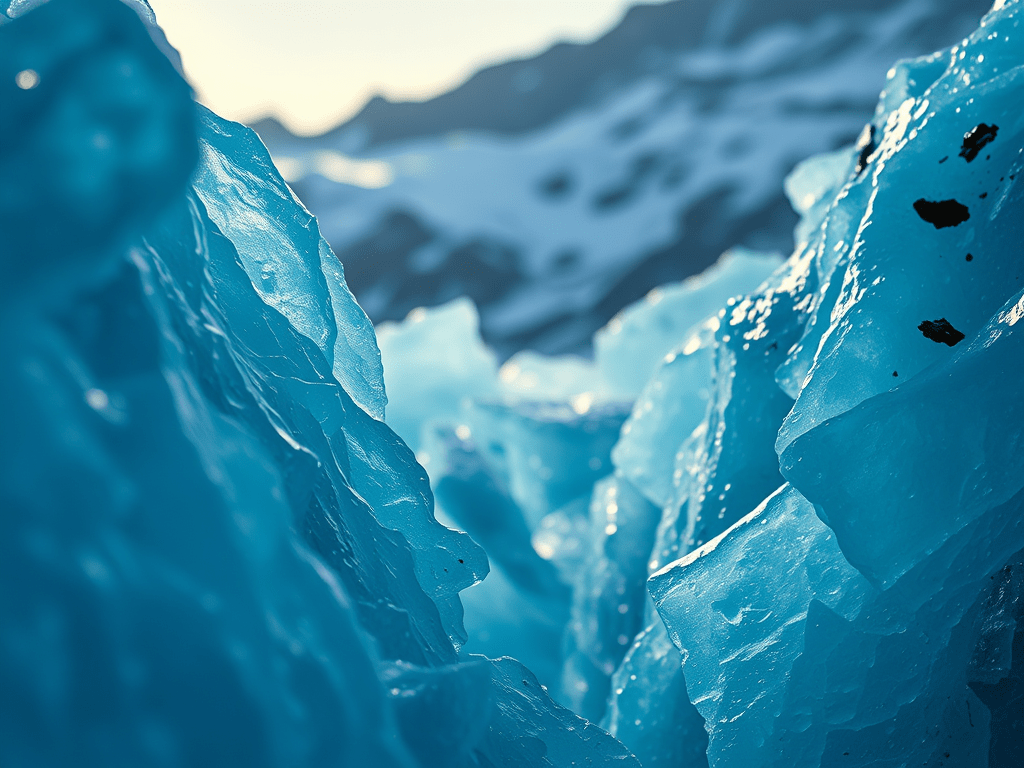
Blue Ice
This is usually the ideal form of ice that ice climbers look for to climb.
Its blue colour indicates a significant amount of water in its formation.
Due to its elasticity and strength, it offers strong resistance to plantations of ice tools and offers good protections with ice screws.
We can usually use Abalakovs in this type of ice.
Transparent Ice
The transparency indicates a lack of significant water in the ice.
This type of ice is very weak and is prone to break very easily. Placing protections is usually difficult in this type of ice. One can also find this type of ice together with blue ice.
White Ice

The colour indicates a significant amount of air in the ice.
This type of ice is also weak. It is easy to break into this ice with ice tools or ice tools. It is generally better to clear this layer and look for solid ice underneath for placing ice screws.
Ice climbing, the thrilling ascent of frozen waterfalls and ice formations, depends on one crucial ingredient: ice. But have you ever stopped to consider how that ice forms, layer by layer, into the stunning structures we climb?
External factors on the quality of water ice
Cold temperature
Temperature has the most influence on the quality of water ice.
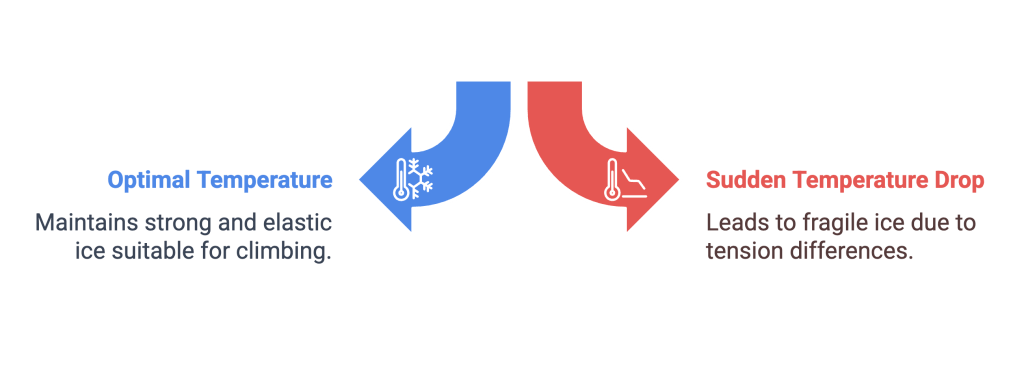
Water ice has the best mechanical properties for ice climbing around -4 °C. Around this temperature, the ice is strong and at the same time elastic enough to withstand any planting of ice tools or screws.
Contrary to intuition, a short period of sudden drop in temperature, such as 10°C drop in 24 hours, will actually weaken the ice and make it fragile. The reason is that this rapid drop in temperature will create a temperature difference between the surface ice and the ice beneath, creating a difference in tension between these two parts. Pay special attentions under this situations!
High temperature
While high temperature can certainly weaken water ice significantly, it depends on the dose and duration.
If the temperature is slight above 0°C during the day and falls below 0°C at night, this allows a good refreeze of the ice.
However if,
- high temperature persists for several days above 0°C day and night, or
- there are big variations of temperature between day and night,
this will significantly weaken the ice
Also take care when climbing on icefalls with dropping water, the combination of liquid water and heat can quickly melt and weaken the ice.
Sunlight
The effect of sunlight on water ice is generally positive, as long as the temperature remains negative. In this condition, the ice is elastic and can tolerate shock and vibrations from ice tools or screws.
Rain
Rain is one of the most annoying enemies against water ice. It has the tendency to abrupt waterfalls and detach them from the rock. In these cases, the icefalls can lose their mechanical supports and sound a bit empty underneath. On surface, rain ‘washes’ all irregularities of the icefalls.
Combined with other negative factors, icefalls can become very fragile. Rapid temperature drops or prolonged high temperatures can weaken icefalls. This can cause them to completely fall down.

Snow
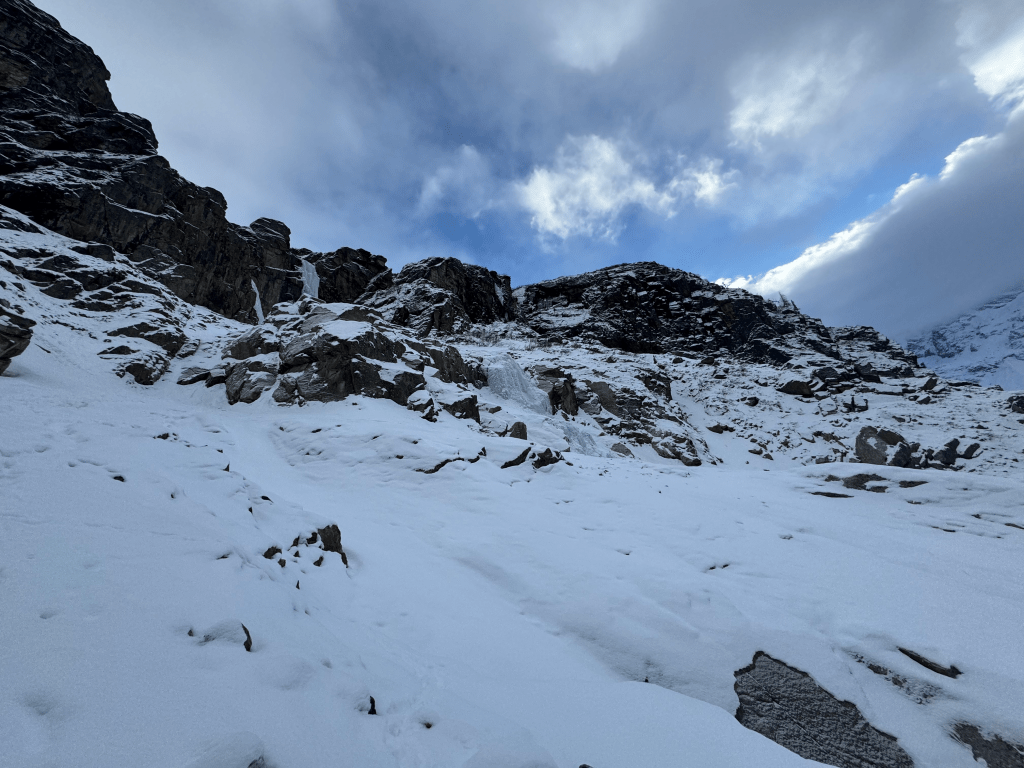
Snow does not generally have significant effects on the quality of ice. However, it covers the icefalls visually. This makes it difficult to judge the ice’s quality without cleaning. Snow covers can transform into ‘fake ice cover’. This breaks upon a few hits by ice tools. One needs to rigorously clean these covers to reach ice with better quality underneath.
Special ice structures
Stalactites and cones
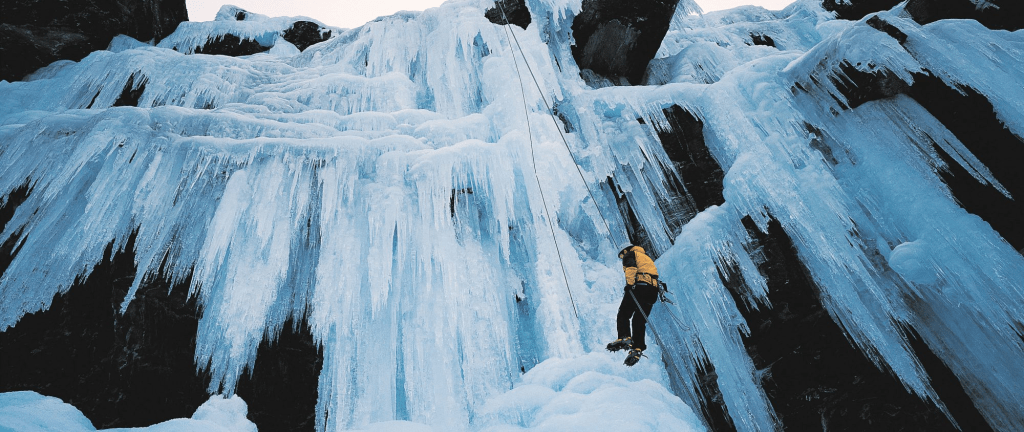
Stalactites in icefalls form through a combination of dripping water, freezing temperatures, and the gradual accumulation of ice layers. They resemble their rock counterparts in caves but are made entirely of ice. Here’s how they form step by step:
1. Dripping Water Source
- Water flows down the surface of the icefall from a natural source like melting snow, a glacier, or groundwater seepage.
- As the water flows, small droplets form at overhangs or edges where the surface geometry changes.
2. Freezing of Water Droplets
- When the temperature is below freezing, the water droplets that accumulate at the overhang begin to freeze.
- This typically happens first at the edges, where the water cools faster due to exposure to cold air.
- Each frozen droplet adds a small layer of ice, forming the initial tip of the stalactite.
3. Continuous Growth
- As water continues to drip down the surface, it flows over the frozen layer.
- The cold air around the icefall causes the dripping water to freeze incrementally, layer by layer.
- Over time, this process elongates the ice stalactite.
4. Shaping by Airflow
- Air currents in the environment can affect the shape and orientation of the stalactite.
- If there’s wind or uneven airflow, the water might freeze unevenly, creating curved or irregular stalactites.
5. Factors Affecting Formation
Several environmental conditions influence the size, shape, and rate of growth:
- Water Flow: A steady, moderate drip is ideal; too much flow prevents freezing, while too little limits growth.
- Temperature: Consistently subfreezing temperatures are necessary for stable growth.
- Surface Geometry: Overhangs, cracks, or protrusions encourage droplet formation and stalactite growth.
6. Connection to Stalagmites
In some cases, if a stalactite drips water that freezes below it, a corresponding stalagmite of ice can form on the ground. Over time, the stalactite and stalagmite may connect to form an ice column.

Columns
Formation Process:
- Water Source:
- Columns form when dripping or flowing water from an overhang or vertical cliff face freezes into a vertical pillar.
- This often occurs beneath waterfalls or seepages where water drips consistently in the same spot.
- Freezing and Growth:
- As water drips down and freezes layer by layer, it builds vertically downward, forming a solid ice structure.
- Consistently subfreezing temperatures are critical for maintaining the column’s stability and allowing it to grow.
- Shape:
- The shape is cylindrical and can vary in diameter depending on the water flow and freezing rate.
- Environmental Influence:
- Wind and uneven water flow can create irregularities, but columns typically appear smooth and straight.
Climbing Characteristics:
- Columns are solid and offer climbers stable, vertical routes.
- Their thickness and stability vary; newly formed or thin columns can be fragile.
Cigars
Formation Process:
- Water Source:
- Cigars form in situations where water flows consistently in a single, thin stream, such as from a crack or small hole in the rock face.
- The flow freezes from the outside inward, gradually encasing the stream of water.
- Freezing and Growth:
- The outer surface of the water stream freezes first, forming a hollow shell.
- As freezing progresses, the shell thickens, and the interior may freeze completely if water flow diminishes.
- Shape:
- Ice cigars are narrow and elongated, resembling a stalactite but growing more robust as freezing continues.
- Environmental Influence:
- Wind can cause slight curves or twists in the structure.
Climbing Characteristics:
- Ice cigars are often thinner than columns and can be more fragile, requiring careful assessment before climbing.
Summary
In this post, we explore the fascinating world of icefalls, focusing on the following points:
- Main Types of Ice: Blue ice, transparent ice, and white ice, each with distinct properties that influence their quality for climbing. Blue ice, strong and elastic, is the ideal choice, while transparent and white ice are weaker and more fragile.
- External Factors on Ice: Temperature plays a crucial role in the quality of water ice. While -4°C is optimal, rapid drops or prolonged high temperatures can weaken the ice. Sunlight can have a positive effect when temperatures remain below freezing, but rain and snow often reduce climbing safety.
- Special Ice Structures: Stalactites, columns, and cigars form under unique conditions of water flow and freezing. Stalactites grow from dripping water, columns from vertical drips forming solid pillars, and cigars from thin water streams encased in ice, each offering different challenges for climbers.
Lastly, we focus on water-formed ice, which differs significantly from ice created from snow. Understanding these differences and the external factors affecting icefalls is crucial for safe and enjoyable ice climbing. For more on snow-formed ice, visit here.
 Mountain Story Blog
Leave a comment